


Ladies and Gentlemen,
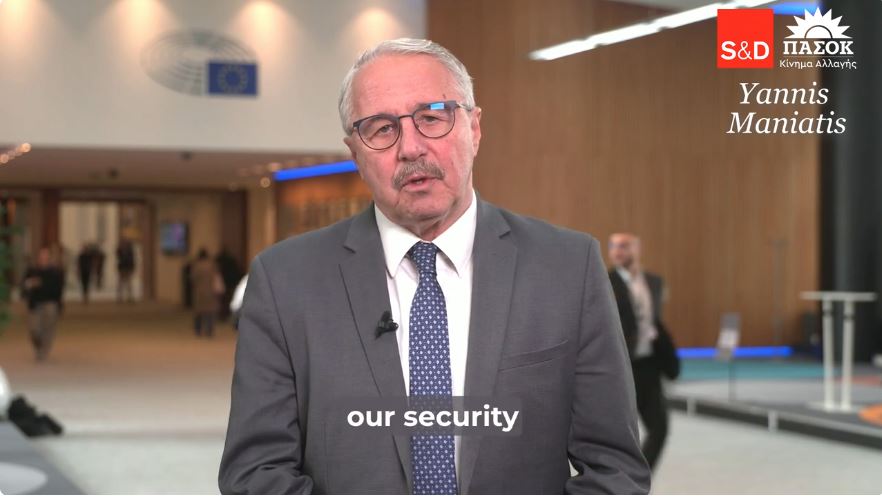
I am very happy to be able to address you, even through this video on an issue that it is very important and I have worked intensively in the European Parliament as the Vice President of the Socialists and Democrats for Security and Defence.
Europe is at a turning point. For decades after the end of the Cold War, we lived with a comfortable illusion — the illusion that our security was guaranteed by others, that defence was an embarrassing subject, which should be left off the European agenda, and that NATO and the United States would always be there to underwrite our safety.
That illusion is now shattered.
The Russian invasion of Ukraine, the instability across our wider neighbourhood, and the shifting posture of the United States have brutally reminded us of a simple truth: security cannot be outsourced indefinitely. Europe must be willing and able to defend itself. And to defend itself, it must be able to arm itself.
This is no longer an abstract debate. It is a matter of strategic urgency.
The numbers tell part of the story. European defence spending has risen from around 240 billion euros in 2022 to close to 450 billion euros in 2025, already reaching the NATO target of 2% of GDP. NATO Members have now set a new target of 5% by 2035, with a substantial share dedicated to equipment and capabilities. At the European level, the Commission has proposed a 130 billion euro envelope for defence in the next Multiannual Financial Framework, alongside 150 billion euros through the SAFE initiative and the activation of the national escape clause worth up to 650 billion euros over the coming years.
These are extraordinary figures. But we must be honest about what they mean — and what they do not mean.
More money alone will not make Europe more secure.
It depends entirely on how that money is spent.
And right now, the way Europe spends its defence budgets is, frankly, strategically incoherent.
According to the Draghi Report, approximately 70 to 80 percent of European defence spending has historically flowed to non-European suppliers. In practical terms, this means that as European taxpayers are being asked to spend significantly more on their security, the overwhelming share of that money leaves Europe and supports foreign industries, foreign workers, and foreign technological ecosystems.
As we now dramatically scale up our defence budgets, continuing this pattern would be not just an economic mistake but it would be strategically suicidal.
There is a second problem that the money alone cannot solve: fragmentation. European armies currently operate a lot of very different and some times incompatible tanks, frigates planes. This fragmented landscape drives up costs, creates practical problems in case of deployment and prevents the economies of scale.
This is precisely where the European Union has a decisive role to play: fostering cooperation between Member States through:
- joint procurement and joint development of capabilities;
- pooling resources for research and innovation;
- reducing dependencies on third countries;
- and developing the strategic enablers that no single Member State can produce alone.
The European Defence Industry Programme, EDIP, for which I was the Rapporteur for the Socialist Group from the Industry Committee, represents a major step in this direction.
It creates the framework for moving from fragmentation towards coordination, from individual laboratories to shared production lines, from twenty-seven separate defence ecosystems to one coherent European industrial base.
At the heart of this effort lies a principle we must defend with clarity and conviction: European Preference.
Let me be direct. European taxpayers’ money should primarily serve European security, support European industry, and create jobs in Europe.
This is not protectionism. It is common sense.
Every euro of European funding spent on defence must strengthen our collective capacity, build our industrial sovereignty, and reinforce our independence from non-European suppliers.
When we talk about European Preference in this context, we are not talking about excluding the world.
We are not building a fortress. We will continue to cooperate with likeminded partners, the United States, the United Kingdom, South Korea and Canada. But when European money is at stake, the primary beneficiary must be Europe and European citizens.
This principle also connects directly to the concept of design authority, a hard-won achievement in the EDIP negotiations. Design authority means that any capability developed with European funding must be free from third-country restrictions.
We must be able to modify it, deploy it, and transfer it as we see fit, without requiring the permission of any foreign government. In a world of geopolitical uncertainty, this is not a technical detail. It is a fundamental condition for genuine strategic autonomy.
A strong European Defence Industrial Base is not only about the large prime contractors — the Leonardos, the Airbus groups, the naval giants.
It is about the entire ecosystem: the small and medium-sized enterprises that provide advanced components, software, materials, maintenance and specialised services.
Smaller member states, which lack major defence champions, can and must become integral parts of this new European industrial architecture.
European defence spending must create jobs across all our regions — not merely concentrate wealth in the already dominant industrial hubs.
Fair participation of SMEs, regional cohesion, and long-term sustainability beyond individual project cycles must be built into the architecture of every instrument we design.
Concluding, I would like to undermine that Europe and Greece have a historic opportunity in front of us. The geopolitical moment is forcing us to support our defence capabilities and industry. The financial resources are being assembled. The institutional framework is being constructed.
We should take advantage of this opportunity and create a Defence Industrial Base serving a dual goal:
First, increase our Strategic Autonomy and
Secondly, support the regional cohesion by creating jobs across Europe.
Thank you very much for your attention.